Showing posts with label industrial sewing. Show all posts
Friday, July 29, 2016
The Industrial Sewing Certificate Program is Back for the Fall
Have you ever wanted to start your own fashion line and didn't how to sew? Or do you just want to learn how to sew to get a career as a production sewer? Well, then you're in luck.
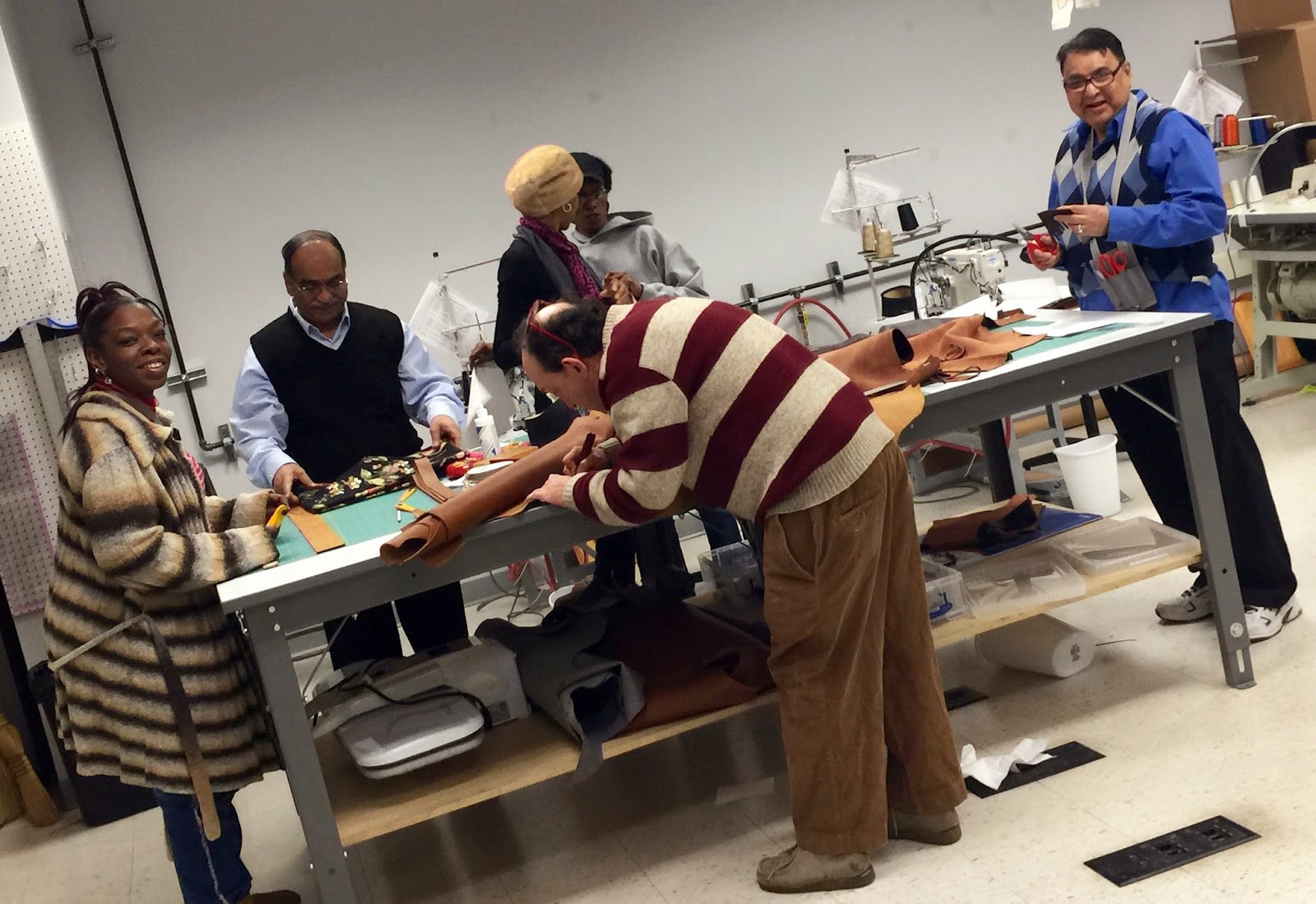
The Industrial Sewing Certificate Program is back and teaches students with entry-level skills to operate sewing machines and tools that are associated with the sewing industry. Some of the topics taught include safety, ergonomics, various sewing machines, stitches and finishes, set-up and quality. Students will even get the opportunity to practice on all different kinds of materials, such as woven, knits, expanded vinyl, fine fabrics and leather. Basic maintenance and troubleshooting skills will also be covered.
Upon completing the program, students will be able to find employment in various industries, including: automotive sewing and interiors, clothing manufacturing, boat canvas and interiors, awning manufacturing, upholstering and much, much more.
The day program runs from September 12, 2016 to October 21, 2016 Monday through Friday 9 a.m. to 3:30 p.m., and the night program runs from August 22, 2016 to December 21, 2016 Mondays, Wednesdays and Thursdays, 6 to 9:30 p.m. All classes are held at M-TEC at Henry Ford College at 3601 Schaefer Rd. in Dearborn. Tuition is $2,000, and for more information call Jan Artushin at 313.3176604.
Friday, March 11, 2016
Industry Spotlight: Industrial Sewing
We've talked to so much about the Industrial Program, we thought it would be great to interview some one who has been through it and gotten a job in production sewing. Jaclyn, who was one of the program's first students, took the time to answer a few questions about what it's like to be an industrial sewer, and tips for anyone looking to learn this skilled trade.
DGG: Tell us about your job as an industrial sewer.
Jaclyn: I was previously responsible for the stitching on Shinola's leather watch bands at the factory in Detroit. Besides producing enough straps to fulfill the daily quota, I spent a lot of time reworking/resewing/saving otherwise rejected pieces. Part of my creative responsibility was figuring out ways to be more efficient while maintaining a high quality standard, including working with 1-2mm tolerances, needle and thread limitations, and varieties of leather. I also operated up to 2 automatic sewing machines at a time.
DGG: What made you want to learn how to sew?
J: I taught myself how to mend my own clothes by hand, so machine sewing was a natural and desired progression. When I found out about Henry Ford M-TEC’s industrial sewing program, I had the reaction to enroll right away. I also always admired the skilled ladies who participated in/made/wore their own clothes for art and charity; The Uniform Project (2009) [http://www.theuniformproject.com/] and Project Makeshift (2009) [http://makeshiftproject.blogspot.com/]
DGG: What has been your favorite thing to sew?
J: So far, I enjoy working with heavy duty materials.
DGG: For people interested in a career as a production sewer, what would be the three most important things you would tell them?
J:
1) Master top and bottom thread tension.
2) Experiment with different materials, thread weights, and needle sizes; this helped inform my problem solving process.
3) Use the metric system for measurements, it's easier and more precise.
1) Master top and bottom thread tension.
2) Experiment with different materials, thread weights, and needle sizes; this helped inform my problem solving process.
3) Use the metric system for measurements, it's easier and more precise.
DGG: Do you do any at-home sewing now that you are a trained sewer?
J: Mostly clothing repair.
DGG: What does your sewing space look like at work?
J: I try to keep my space as organized as possible so I can find my tools right when I need them. Most sewing machines have their own storage compartment under the table. Regarding mobility at my previous employer, there was a lot of back and forth between quality control at the end of the line and the stations before and after my sewing area. We collaborated on issues we were having with different straps and shared a lot of tips, tricks, and techniques with each other.
DGG: Describe your style.
J: I maintain a minimal wardrobe. A goal of mine is to be able to make my own clothes so I can eventually teach others how to do it themselves, too.
DGG: Vinyl or leather?
J: Both!
DGG: Straight stitch or Zigzag stitch?
J: I work primarily with a straight stitch, but I totally dig the variables of a zigzag.
Monday, January 25, 2016
Guest Blog: DGG is on Visit Detroit!
If you haven't seen our Facebook post, we've written up a blog post about the 7 reasons why we think Detroit is a fashion city. Below is an excerpt:
![]() |
| Photo credit: Jacqueline Paetzold |
You know that old saying “if a tree falls in the forest and no one is around to hear, does it really make a sound?” The same can be said for fashion in Detroit. Just because people don’t know about it doesn’t mean it’s not here. In fact, it’s everywhere. Detroit is on the cusp of a fashion explosion, and we have seven examples to back up this statement:
1. Nationally Recognized Fashion Designers
What do Tracy Reese, John Varvatos, Anna Sui, Vicki Sarge and Kevan Hall all have in common? These Michigan natives, and their namesake brands, are staples in the fashion world — and for good reason. All have participated in the Detroit Historical Museum’s fashion exhibition, Fashion D.Fined: The Past, Present and Future of Fashion in Detroit, which runs through fall 2016.
John Varvatos opened a store in downtown Detroit; Tracy Reese and Kevan Hall were keynote speakers at FashionSpeak, an annual conference from Detroit Garment Group(DGG) that focuses on the business of fashion; and Anna Sui has spoken at a Penny Stamps Speaker series put on by The Institute for the Humanities and Detroit Creative Corridor Center (DC3).
2. Budding Local Designers and Brands
...
To see what else we had to say, click here: http://blog.visitdetroit.com/blog/entry/fashion-city.html.
Friday, August 7, 2015
Industry Spotlight: Local Designer Uses Her Passion to Help Others in the Industrial Sewing Program
![]() |
| Image from Rachna Chandra |
DGG:
Tell us about yourself, Rachna.
Rachna Chandra: I migrated to Michigan in 1997 from India, and I hold a bachelors degree
in science and an associate degree in Computer Information System from Henry
Ford College. As my name means creation, I always want to do something
innovative. Since I was a kid, I wanted to be a fashion designer, and I am
proud to successfully celebrate 10 years of my fashion design business, Taj Cottage. Taj Cottage is a collection of ethnic Indian and fusion wear. I have been sewing since elementary school, and I
have also learned a lot about sewing from my mom. I am happy to say that my daughter
has inherited the same talent, and my son wants to learn, too.
DGG:
Tell us about the Industrial Sewing Program at Henry Ford College M-TEC.
RC: Being a member of different
fashion groups and Detroit Garment Group, I found out about the Industrial
Sewing Program and instructor position at Henry Ford College M-Tec. It was a
great opportunity for me to teach the art of sewing and keep it alive. The
Industrial Sewing Certificate program is a one-of-a-kind, six-week program.
Students learn different seams and stitches, precision, speed, quality control,
work ethics, basic sewing machine repairs and more; they also work with a variety
of industrial sewing machines, and gain knowledge about different kind of
fabrics, needles and threads. We even take the students for field trips to
companies like Irwin, Shinola, Magna and TDIC, where they get to see, first
hand, the manufacturing departments of cut and sew companies.
![]() |
| Image from Rachna Chandra |
DGG:
Describe your job in 10 words.
RC: Creative. Fashion. Pride.
Exquisite. Vogue. Addiction. Couture. Trend. Innovative. Designer.
DGG:
What has been the most rewarding thing about working as an instructor in the
sewing program?
RC: It is very satisfactory
and rewarding for me when the students are employed, and they thank me for teaching
them a skill to be able to earn a decent living.
![]() |
| Image from Rachna Chandra |
DGG: If you could be remembered for one thing, what
would it be and why?
RC: I would like to be
remembered as a sewing mentor, a kind-hearted person and someone who made a
positive impact on peoples lives.
DGG: If you could sew for any of the famous fashion
houses, who would it be and why?
RC: I would be honored to
sew for Dior, if given a chance. I find some kind of similarity between Dior
designs and my personality, which is Uniqueness.
DGG:
Describe your style.
RC: My style is to feel
beautiful and confident in what I wear.
DGG:
How do you take your coffee?
RC: Coffee with cream and
sugar.
DGG:
Nordstrom or Macy's?
RC: Nordstrom.
DGG:
Cotton or linen?
RC: Cotton.
Tuesday, March 3, 2015
A Letter From DG3’s President: Education Is at the Heart of Your Success – Whatever Type of Education that Needs To Be
By Karen Buscemi
It’s hardly profound to state the importance of education. However, people often get hung up on the type of education that’s needed to have a “successful life”. The high-school-to-college path, while certainly a fine plan, is not necessarily the right choice for all. And we all know those who’ve gone the college route without achieving desired career goals, or job satisfaction, for that matter.
Education comes
in as many flavors as Baskin-Robbins. You shouldn’t be afraid to sample many,
but at the same time, if a particular one floats your boat, you shouldn’t be
afraid to stick with what works for you. (And now I’m craving
chocolate-chocolate chip.)
Yes, college is great. An advanced degree may be even better
to get to the profession you want. But what if you tried college classes and
found they weren’t for you? What if circumstances made college an impossibility
for you? What if you got your degree and then found out you hadn’t learned all
you needed to succeed in your industry? What if your career goals changed and
now you need to learn a new industry?
Thankfully, continuing education abounds. For everyone. For
some, becoming educated in a skilled trade is a wonderful solution. Skilled
trades, along with their desirable apprenticeships, include manufacturing and
construction, and provide a living wage, with the median income in Michigan, asof 2013, being $21 an hour. There is high demand for skilled workers, and that
demand will continue to grow, as the current aging workforce retires in the
next five to 10 years. Some skilled trades offer on-the-job training, and for
many, educational programs are short term and provide immediate employment
opportunities upon completion. Our Industrial Sewing Certificate Program is an
example of a skilled trade in Michigan. With more than 300 open jobs, and
again, more coming in the next five to 10 years, there is great opportunity for
advancement in both position and pay. And funding is available for those who qualify through Michigan Works! Daytime education takes only six weeks,
on a full-time basis, and upon completion, employment is readily available.
When evening classes start at the end of March, it will take 17 weeks to be
ready for employment as an industrial sewer. Pattern making and sewing machine
repair classes will begin the end of spring – two sorely needed pathways that offer
higher wage opportunities.
For fashion designers coming out of a four-year degree
program, if your goal is to start your own fashion business, you are going to
need continuing education if you want that business to succeed. As fashion
schools do not teach business classes, you don’t have the knowledge to write a
proper business plan, create financial projections, or determine funding
sources, your supply chain, line pricing and so much more. Our Fashion Incubator, launching later this year, along with our continuing education
monthly workshops, will affordably fill that knowledge gap, allowing you to
thrive as a Michigan business owner, hopefully hiring others along the way.
For me, I never stop learning. From starting a nonprofit
more than two years ago to launching my own for-profit business, I rely on gads
of books, tons of Internet research and picking the brains of those way smarter
than me. I enjoy the challenge, and it sure keeps life interesting.
Whether it's a class, book, seminar, podcast, webinar, etc., find the form of education that suits your current situation and pursue it wholeheartedly.
Never stop learning.
Labels:
advanced degree,
college education,
continuing education,
detroit,
entrepreneur,
fashion design,
fashion incubator,
industrial sewing,
manufacturing,
skilled training,
starting a business
Subscribe to:
Posts (Atom)